Interview with Jean Genet
 January 24, 2000
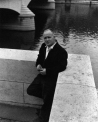
I'm interviewing Jean Genet by way of a postcard of him propped up against the monitor where it has been for many months. {Or, he is interviewing me, one can never be sure...}
In this image from 1951, he is leaning into the angled corner of a bridge or other stone structure, his elbows resting on it as he leans back into it. He is wearing a black denim jacket, a white open-collared shirt, and black cords, cuffed and longish on him. His jacket is zipped halfway up. He has an unlit cigarette cupped in his hands, or perhaps it's the jacket zipper.
He gazes out directly and intently, his expression sober, intense, thoughtful, sincere. One knee is bent, his foot propped behind him against the structure. The structure is on a river or a canal. In 1951, Genet would be 41 years old.

GENET: Oh, I don't smoke anymore.
You don't?!! Why give up smoking if you're dead? It seems the time to smoke with impunity.
GENET: That's just the point. I'm dead. No more prisons, no particular need for the smokes.
No more prisons ... no more smokes ... hmm.
Well, I hear you say that in two different ways. The literal prisons you inhabited, or perhaps you mean "the prison of life"?
GENET (smiling a sly and subtle smile):
Yes, the prisons I occupied literally were my
playgrounds. And cigarettes were a measure of
coinage ... implements of seduction ... they were
pose and poseur, part of the ballet of the romances
and wars behind bars ... the arbitrations of
touched hands ... of eyes lowered or risked in
connection ... purchasers of silence ... among
other means of message conveyed from the scraps
allowed us.
The prison of life? — of course, but I leave that for you. (Laughing.)
I recall reading that ... probably from Miracle of the Rose... how, in Mettray, though your prison community wore the same assemblage of clothing, it might be altered, worn differently, signaling affiliations, identification with status, philosophy, current standing with a lover. So, cigarettes played such roles, too.
The "prison of life". One wonders why life is glorified in and of itself, when it means only to noose you in its concrete reality, and watch indifferently as you twist and writhe your way through the eye of a needle ... and, by doing so, unwittingly weaving yourself a new and improved noose to hang you some other year.
GENET: ha ha ha ha ha
But you got it, Jean. You made of your noose the silken snake of your embrace. And you kept on, beautifying each noose that came for the hanging — you hung beautifully. You know you are one of my top 5 admireds for having lived a life in erotic attention for your circumstances and nature.
GENET: Well, thank you, Inka. It's all laughable and unspeakable, now.
For you. But I'm still twisting and writhing.
GENET: ha ha ha
A passage from Miracle of the Rose:
The noise of the lock as it gives way, the silence that follows, and the solitude that always besets me will govern my criminal entrances. These are rites, the more important as they are inevitable and are not adornments of an action whose essence is still mysterious to me.In this passage I find some expression of what I mean by an erotic attention, which you display so beautifully in all of your work. Your sensual involvement in an act, as if Time is suspended ... you have entered fully into a moment by which you are the tool in your hand — your icon, the lockpick.
It makes me think about your Nature ... the essential nature of Jean Genet.
I think of the fundamental Solitude of any artist or genius, the isolation inherent in expressing the core of your singular nature.
That art/genius has to do with becoming immersed within ones singular nature, and refusing to compromise the expression of that essence for the sake of conditioned social impulses. Or, maybe for any sake.
Taken to extreme, which I am given to advocate, at some point you cannot even afford to take in the "impressions" of others who wish to embrace you with their own ideas of you ... so stingy with itself becomes self reflecting self, the sense of "going all the way" in reliance upon what you reflect as truth from within.
Did you act only from impulses in becoming a thief and a prisoner, or were you aware of, or have any concept of the feeling of your Nature as a sort of mystery that impelled you, that was beyond the Jean living his life, compelling you to live up to it?
GENET: I was sensually drawn to the acts of my life. There was a tangible beauty in action itself. I would be more inclined to emphasize action, rather than nature, as you are doing. Consequence meant nothing to me. I could not be swayed by the abstraction of consequence in the face of the allure of action. Consequence brought only a new formula within the game of actions. There was no end to my eagerness to take up the challenge of the new field of action garnered from consequence.
My nature ... I have some idea of what that means to you, but I can't say I thought about it as you express it ... that my nature was a mystery, as if partly inaccessible to my perception of myself.
I was proud of the displays my nature might create in action, but it was action itself and result that captured my attention then, moreso than what might be compelling the acts.
Well, what about now? What do you think of my question now?
GENET: I've said I became myself in becoming the thief. So saying, you say my "nature" was bigger than, or beyond my lived life ... drawing me to fulfill it. I can agree with you, but I did not perceive my nature as somehow separate from my lived life. I was more concerned with going to the next level, pursuit in terms of action, acting upon what I wanted. I was not preoccupied with such a thought, or question.
Why are you?
Maybe because I'm not a man, action is not as compelling.
My imagination perceives allure by an inaccessible Nature unfolding in its own precise time and means, that I cannot manipulate. The way it lures me, by attraction and assimilation has a certain elegance to me, I guess.
As if I am in a passage, the labyrinth of my own making. And it is proceed, advance, and sometimes stall. Thinking and questioning is stalling. Perception without question or explanation moves me. There is no turning around. Stopping is failure. Not death, but failure. Incompletion. "Worse than death". I say, quoted, because I can't use the phrase. I can't think of death as a bad thing.
I have the feeling of it as somehow related to Death. As if Death may be the attractor, may be the ultimate Nature. That Death is a completion, the accessibility of totality of the self brought together. The details and distractions of living is a leveler ... life/living separates me into two unjoinable things.
These are my thoughts as I speak to you, but I don't know what I think of them. It doesn't seem necessary whether I believe them or not.
GENET: You're kind of funny.
Probably because I'm not dead yet. I'm immature.
I can't resist quoting another beautiful erotic attention; this or your lockpick:
I did not get my first jimmy from a yegg, I bought it in a hardware store. It was short and solid, and, from the time of my first robbery, I held it as dear as a warrior his weapons, with a mysterious veneration, as when the warrior is a savage and his weapon a rifle. The two wedges, which lay next to the jimmy in a corner of my room - the corner quickly became magnetic, hypnotic - lightened it and gave it that air of a winged prick by which I was haunted. I slept beside it, for the warrior sleeps armed."...that air of a winged prick by which I was haunted." The numinous air of attention ....
I am much enamored with your sense of ritual, rites and icons.
"...the warrior sleeps armed" . I love that. I have some affinity with being a warrior.
GENET: Thanks. You give me a moment of nostalgia.
I quote the following line to ask a question:
Does this mean that attraction is possible only when one is not entirely oneself?I wonder if we ever really love another, or if we only covet something we're searching for that appears to reside in another. Can human beings really and truly love one another, or does their humanity preclude it. Are we only convincing ourselves that we really love an other, because we cannot bear ourselves without thinking so? Is it just a conditioned insistence we blind ourselves with?
It seems that the state of relationships would not be the crazy, compromised state of lies entangled in psychological reaction and blind impulse most domestic scenes appear to be, unless something intrinsically human were not in the way.
Are we attracted to an other for the Image
developing within ourselves?
Is this the trick and the use of attraction, love?
GENET: I'm not going to answer, Inka, because you have to keep on being human. You have to keep on fighting. Keep on twisting and writhing with your questions, with the impossible contradictions. There are things the dead don't tell.
Damn. And I keep asking.
GENET: Your philosophies are so complicated you tangle up in the details. But you've always known that. You aim toward things from every conceivable angle, narrowing in on it maybe, but juggling so many possibilities at once your contradictions confuse you every time. Though you know the contradictions are fine and belong side by side, you still falter because of them.
I think you just talk too much. Use too many words....
Anyway, regarding your relationship/love questions, I'd rather watch you work it out.
Loan me your jimmy, but bless it for me first, and I'll pick your lock.
This just occurred to me: does my progress with the labyrinth do anything for you who are dead?
GENET: If you succeed in becoming yourself it will.
Another passage, Jean, and I'm not letting you off the hook of love, either.
I tried hard to be gracefully casual, but I was weighed down by all that love and I remained solemn. Love made me ascribe infinite importance to my gestures, even those to which I would rather not have done so.I find myself sharply pinned in that passage. So my questions about love to you.
It is my fear of inherent human lies, blind and blindsiding us, that causes me to handcuff myself to a discipline of imagining what we love has less to do with an other than it has to do with loving ourselves loving. I impose upon myself this rather severe stance of self-doubt — while everything about me loves intensely and fiercely and with conviction when I love. I force a condition of contradiction within myself regarding myself loving, and yet don't believe in the doubt I force into existence. It's my game of discipline. To force the doubt to remain present ignites action, works of love as energy.
But yet do I believe that the freshly drawn blood of our moment, or scant glimpse, wherein we feel love for an other, that expression/gesture of love in that moment is true and eternal, and only the passage of time, trying to sustain, maintain, repeat gestures become as proofs calcifying layers of lie upon the singular moment, the crest of the wave, as and when it occurs.
I love — but at great odds with Time, or with the human relationship to Time. That necessitation of a "behavior" defined and scheduled.
My gesture in the moment's wave must contain the whole of my eternal love for an other. My daily behavior, or even hourly behavior won't be chained to that moment propping it up, or I shall be dead meat, lying, forcing myself to automate a mere mold, and the love become a cold, unanimated edifice that can go nowhere else but to crack and fall.
GENET: You are talking as if you are Dead,
Inka.
But you're not, so I must chuckle.
You can't be risking these questions among your
loves and lives easily.
Not while they're listening, anyway.
I reflect upon your questions. I think we love truly, as you say, in a moment that sustains an eternity of time passing. That moment, we become not ourselves anymore, but are changed, recombined by loving another.
So you keep thinking you are only loving yourself, due to human limitation ... but as you have "taken in" that other in your moment of Love, to love yourself loving is to love the other.
It is the adaptation to whom one newly becomes. One becomes entrenched yet again by Time, and no longer really loves if hanging on to that one moment that must be allowed its passage. One is living, one is behaving loving. But that is not the same as the love you refer to.
Right, usually the human nature continues to hoodwink itself into thinking what is called love by the daily demonstration, a prop and proof, a mere shadow, an xray of that original eternal moment of truth ... that love is not the real love. It is a love, and it is real — but it is not the love you are particularly referring to.
But don't tell anyone. Nobody will like you.
Too bad. They usually end up loving me in spite of not liking me. I can't keep my mouth shut.
GENET: My life was lived on high burn. I never had the deceleration by which to become entrenched. Domestic relationship, as you call it. Being in love and/or broken-hearted were one and the same, consistently entwined until indistinguishable.
I know exactly what you mean. Thus I am often in love with my broken heart.
"...to her love was equivalent to despair ..."
(Said in Our Lady of the Flowers.)
GENET: We are kind of tangled up that way, aren't we?
Oh, you mean knowing exactly what each other means due to the nature of this interview ....
GENET: I'm not sure I'll forgive you it.
One more passage, Jean. This is a perfect description, again, of what we've been discussing — about the moving face of truth, the eternity of love in a glimpse unheld by Time, and the Erotic Attention:
Certain acts dazzle us and light up blurred surfaces if our eyes are keen enough to see them in a flash, for the beauty of a living thing can be grasped only fleetingly. To pursue it during its changes leads us inevitably to the moment when it ceases, for it cannot last a lifetime. And to analyze it, that is, to pursue it in time with the sight and the imagination is to view it in its decline, for after the thrilling moment in which it reveals itself it diminishes in intensity.This from Miracle of the Rose.
Thanks, thanks and thanks, for being the writer you are, for successfully becoming yourself, for offering me these lenses, these confirmations along the lonely trail of missing breadcrumbs I follow.
GENET: Hey, take heart that you have a working radar for finding the breadcrumbs you need.
I'm about finished with you for now, Jean, and
ready to release you.
But I must bring this up, for I've loved it from
various angles.
I am recalling reading of your visits to the sculptor, Alberto Giacometti. He was to render the portrait of you.
There was a moment when you dropped a cigarette, and in bending down to retrieve it, your foot unearthed a little sculpture lying there, buried beneath the debris of wood chips and other trash.
GENET: That man was sloppy.
But it was meaningful slop.
Giacometti said to you when you unearthed it:
If it is really strong, it will show itself, even if I hide it.Still those words echo, reverberating down my many lost hearts, meaning everything to me.
But tell me, did his words set off any alarms for you?
GENET: Oh. Yes. I was anxious whether I could let him see me unmasked to begin with. But then anxious over the unknown he might reveal. That was the case.
His image of me exposed me in unexpected ways. For the first viewing I felt jealous, and wept—Giacometti's figure was more myself than I, and I should now depart the world, since it was born, or be cursed having to compete with it.
We do exaggerate, don't we?
GENET: "Magnificent exaggeration"!, as you always say.
Copyright © 2000 by inamorata k
<< Home | Printer-friendly version >>